
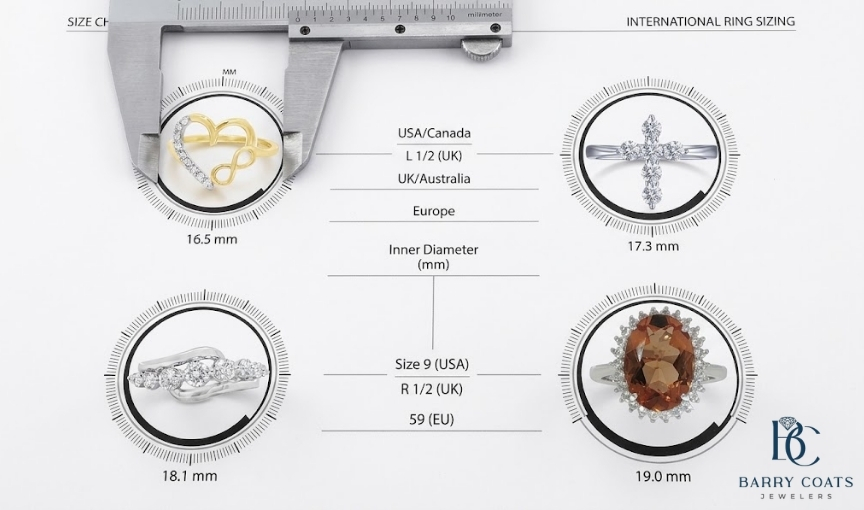
Using International Size Charts for Rings
Shopping for jewelry online gives you access to designs from across the globe. However, buying a band from another country can feel confusing when sizing systems do not match. When you look at international size charts, you will notice that different countries measure fingers in completely different ways. An American size 7 is not the same as a British size N or a French size 54.
At Barry Coats Jewelers, we believe that buying a ring should be exciting, not stressful. Knowing how to read international size charts helps you order the correct fit the first time. Whether you want to buy diamond rings, wedding bands, or custom jewelry pieces, this guide will help you understand every measurement system.
Key Takeaways
- Different countries use different measurements: millimeters, inches, numbers, and letters.
- The United States and Canada share a numerical scale, while the United Kingdom and Australia use letters.
- Ring width matters: wider bands fit tighter than thin bands.
- A professional jeweler provides the most accurate measurement.
Understanding Global Sizing Standards
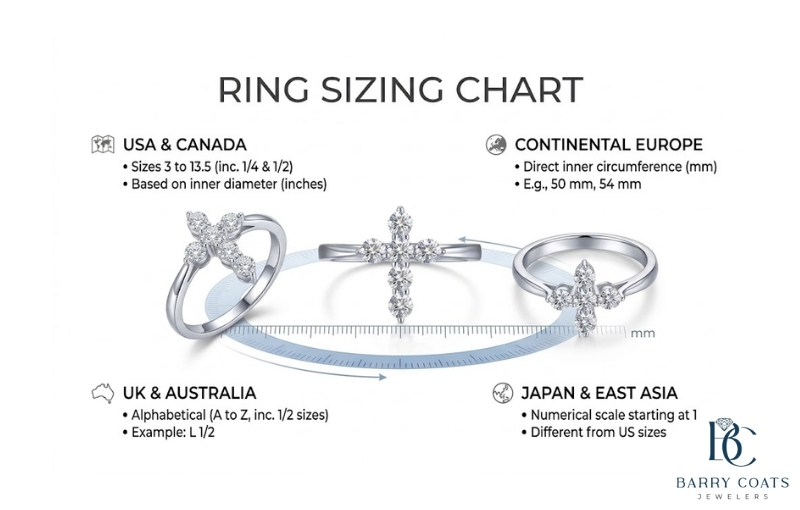
Ring sizing is not universal. Over the decades, different regions created their own methods to measure finger sizes. These global sizing standards mainly fall into four categories:
- The United States and Canada: Uses numbers from 3 to 13.5 (including quarter and half sizes), based on the inner diameter of the band in inches.
- The United Kingdom and Australia: Uses an alphabetical system from A to Z, with half sizes marked as well (such as L 1/2).
- Continental Europe: Measures the inner circumference of the ring directly in millimeters.
- Japan and East Asia: Uses numerical values starting at 1, but these numbers do not match US numbers.
Pro Tip: If you are shopping across borders, focus on the inner diameter or inner circumference in millimeters. Millimeters remain the same in every country, making conversions much easier.
How to Read Conversion Ring Tables
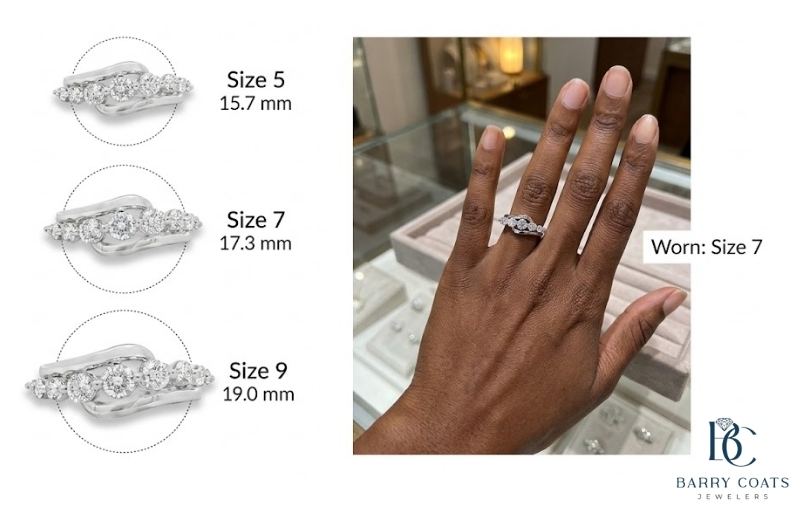
Conversion ring tables allow you to compare your local size to international measurements. Instead of guessing your size, you can match your finger diameter to the correct local scale.
The table below breaks down the most common sizes across popular regions:
| Inside Diameter (mm) | Inside Circumference (mm) | US & Canada | UK & Australia | European Size | Japan & Asia |
|---|---|---|---|---|---|
| 15.3 mm | 48.0 mm | 4.5 | I 1/2 | 48 | 8 |
| 15.7 mm | 49.3 mm | 5 | J 1/2 | 49 | 9 |
| 16.5 mm | 51.9 mm | 6 | M | 52 | 11 |
| 17.3 mm | 54.4 mm | 7 | O | 54 | 14 |
| 18.1 mm | 57.0 mm | 8 | Q | 57 | 16 |
| 19.0 mm | 59.5 mm | 9 | S | 60 | 18 |
| 19.8 mm | 62.1 mm | 10 | T 1/2 | 62 | 20 |
| 20.6 mm | 64.6 mm | 11 | V 1/2 | 65 | 23 |
When using conversion ring tables, remember that rounding errors can happen. Always double-check whether the chart refers to inside diameter (the straight line across the ring opening) or inside circumference (the distance all the way around the inside circle).
Using a European Size Guide
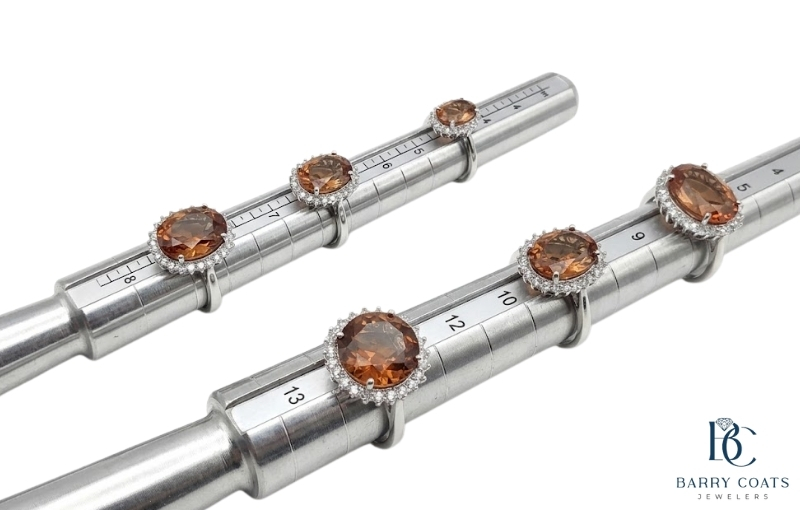
Many fine jewelry designers and vintage sellers follow European metrics. A European size guide is usually the easiest system to understand because it reflects exact metric measurements.
Here is how the European standard works:
- Circumference-based: A European size 50 simply means the inside perimeter of the band measures 50 millimeters.
- Direct conversion: If you measure your finger circumference at 54 millimeters with a piece of paper, your European size is 54.
- No fraction math: Unlike US sizes with half and quarter steps, European sizes usually move in full millimeters.
If you are buying gold jewelry, yellow gold bridal sets, or platinum bands from Europe, check if the maker uses French or German sizing. German sizing frequently lists inner diameter instead of circumference.
Steps to Measure Your Ring Size at Home
Getting an accurate measurement at home requires attention to detail. Follow these steps to find your size:
- Cut a narrow strip of paper: Keep the width around half an inch so it fits like a standard ring.
- Wrap it around your finger base: Make sure the strip sits flat against your skin.
- Account for your knuckle: Slide the paper strip over your knuckle to make sure the ring can slide on and off.
- Mark the overlapping point: Use a fine pen to mark where the paper overlaps.
- Measure the length with a ruler: Place the paper flat against a ruler marked in millimeters.
- Compare your number: Look at international size charts to locate your matching number or letter.
Key Factors That Change Finger Size
Your fingers change size throughout the day. Keep these factors in mind:
- Time of Day: Fingers tend to be smaller in the morning and swell slightly by evening.
- Temperature: Cold weather makes your fingers shrink, while warm weather makes them swell.
- Band Width: Wide bands (6 mm or thicker) fit more snugly than thin bands. You may need to order a half size larger for wide rings.
- Dominant Hand: Your dominant hand is often slightly larger than your non-dominant hand.
The Value of Professional Sizing
Home measurements are helpful, but nothing matches an in-person measurement by a master jeweler. Professional jewelers use metal ring sizers that give an exact feel for the weight and comfort of a band.
At Barry Coats Jewelers, our fourth-generation family business provides full-service ring sizing and adjustments in Livingston, Texas. Whether you are picking out white gold engagement rings, rose gold bands, or custom diamond jewelry, our team makes sure your ring fits comfortably every day. If you already purchased a ring from overseas that does not fit right, our jewelry repair team can help resize it to your exact specifications.
Frequently Asked Questions
Can any ring be resized if I order the wrong size?
Most rings made from yellow gold, white gold, rose gold, and platinum can be resized by a skilled jeweler. However, eternity bands with diamonds all the way around, rings made of tungsten, and certain intricate custom designs cannot always be altered easily.
Are men’s and women’s ring sizes measured differently?
No. Ring sizing uses the same scale for men and women across all major international systems. A size 8 fits the same diameter whether it is intended for a man or a woman. The main difference is that men’s rings are typically broader in width.
What should I do if my measurement falls between two sizes?
If your measurement falls between two sizes, it is usually best to choose the larger size. A ring that is slightly loose is much easier to wear than a ring that restricts blood flow. Your local jeweler can also add sizing beads or adjust the band for a perfect fit.
Visit Barry Coats Jewelers in Livingston, Texas, for friendly service, expert ring sizing, and custom jewelry designs tailored to your style.