
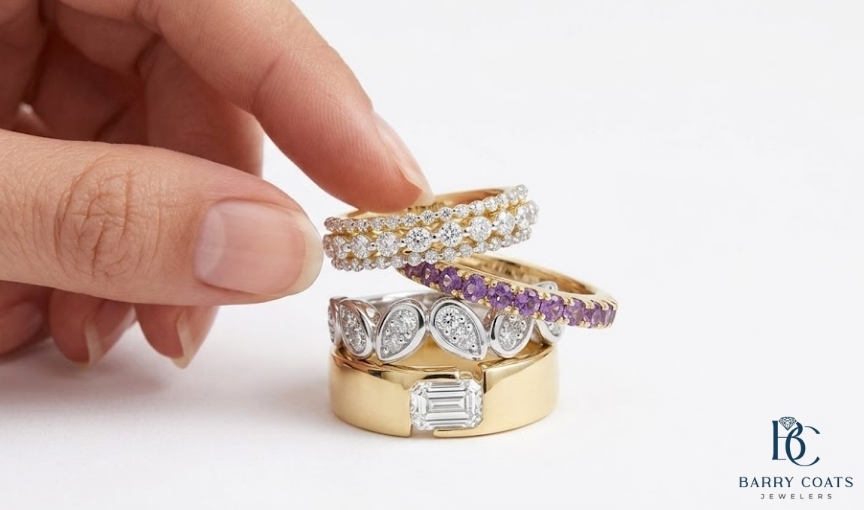
Understanding Standard Fit Rings
When you start shopping for a wedding band or a fine fashion ring, you will quickly notice that rings are built in different ways. One of the most common styles you will find is Standard Fit Rings. The way a ring feels against your skin makes a big difference in how much you enjoy wearing it every single day.
Standard fit rings have been around for generations. They offer a specific shape and feel on your hand that many people know and trust. At Barry Coats Jewelers, we believe that understanding how your jewelry fits will help you make the best choice for your personal daily routine.
Key Takeaways
- Standard fit rings feature completely flat interior walls that rest flush against your finger.
- They provide a secure, snug feel that keeps the band firmly in place.
- Bands with a classic sizing profile are easy to measure and simple for jewelers to resize.
- Your finger shape, band width, and daily tasks will determine if this fit suits you best.
What Are Standard Fit Rings?
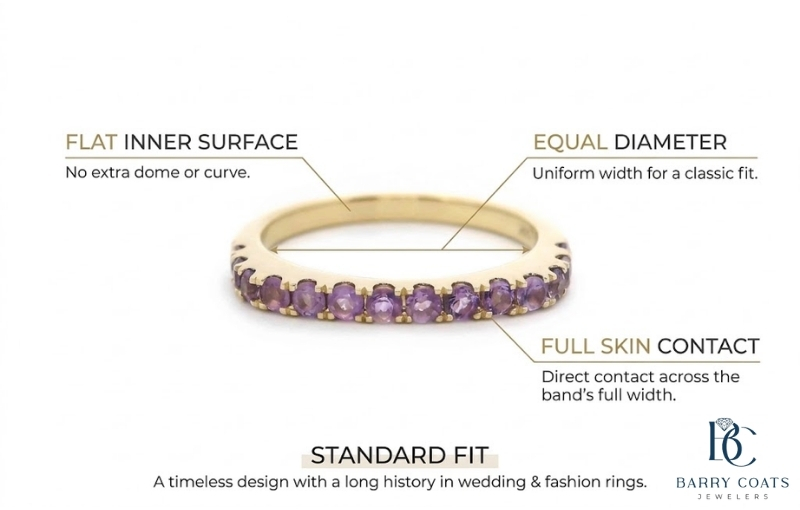
A standard fit ring is defined by the shape of the metal on the inside of the band. If you take a cross-section of the ring, the inner surface is completely flat from one edge to the other.
Key characteristics of this style include:
- A flat interior surface with no extra dome or curve.
- Equal diameter across the entire width of the inside band.
- Direct contact with your skin across the full width of the metal.
- A long history of use in wedding bands and fashion rings.
Because this design has been used for centuries, it is often called the baseline for modern ring sizing.
How Flat Interior Bands Feel on Your Finger
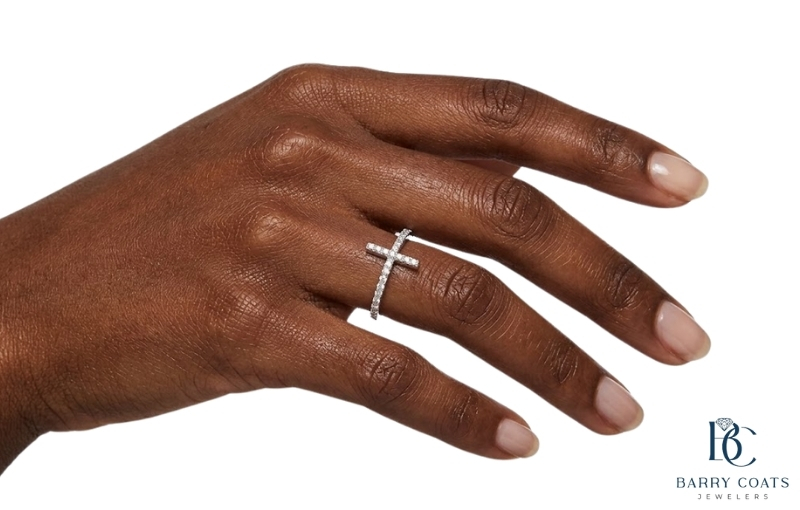
The feel of flat interior bands is distinct from any other ring type. When you slide the ring on, you will feel the edge move straight across your knuckle until it rests at the base of your finger.
Here is what you can expect during daily wear:
- Complete Surface Contact: The metal touches your skin evenly across the entire inner band. This provides a very grounded, solid sensation.
- A Firm Grip: Because more metal touches your skin, the ring creates more friction. This keeps the band from spinning loosely, which is especially helpful if your ring features stones or engravings on the front.
- Direct Edge Contact: The edges of the inner band meet your finger directly. While quality jewelers soften these edges slightly, you will still feel the distinct borders of the band against your skin.
Key Insight: If your fingers tend to swell in warm weather or shrink in cold weather, flat interior bands will make those changes noticeable quickly due to the total surface contact.
Standard Fit vs Comfort Fit: A Direct Comparison
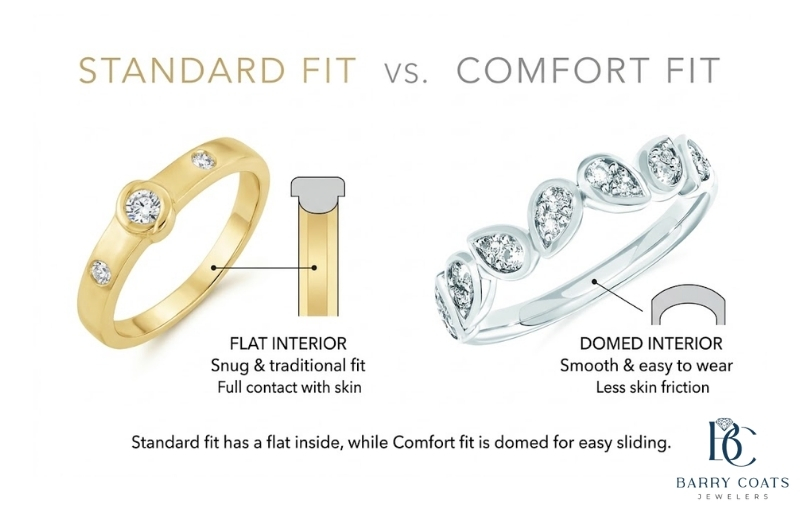
To truly understand how this fit works, it helps to compare it to the other main option on the market: comfort fit. While standard fit is flat on the inside, comfort fit has a rounded, domed inner wall.
The table below breaks down the primary differences between the two designs:
| Feature | Standard Fit Rings | Comfort Fit Rings |
|---|---|---|
| Interior Shape | Full surface contact across the band | Less surface contact; rests in the center |
| Knuckle Movement | Requires gentle push over knuckles | Slides easily over larger knuckles |
| Stability on Finger | High; resists spinning and sliding | Lower; can twist more easily if top-heavy |
| Metal Weight | Uses less metal inside the band | Uses slightly more metal to create the curve |
| Resizing Ease | Very easy to cut, size, and solder | Requires care to protect the inner dome |
The Benefits of a Traditional Ring Fit
Many people actively prefer a traditional ring fit over rounded alternatives. There are several clear reasons why this design remains popular today:
- True-to-Size Accuracy: Most standard ring sizers use flat inner surfaces. That means the size you measure on a sizing stick will match the actual ring right away.
- Lighter Feel: Because the inside is not built up with extra rounded metal, the band itself can be thinner and lighter. If you do not like heavy jewelry, this is a great advantage.
- Budget-Friendly Value: Rings without rounded interiors need less precious metal, such as yellow gold, white gold, or platinum. This can keep the overall cost down without sacrificing beauty.
- Fewer Twisting Issues: If you wear a ring with a diamond setting or a specific pattern, the secure grip prevents the design from constantly turning toward your palm.
Sizing Advice for a Classic Sizing Profile
Finding the right size for a ring with a classic sizing profile takes a little attention. Because the band lies flat against your finger, width plays a massive role in how tight the ring feels.
Keep these sizing tips in mind:
- Check the Band Width: Thin bands (2mm to 4mm) slide on easily and feel true to size. Wide bands (6mm to 8mm) cover more skin and create more friction. You may need to go up a quarter or half size for wider bands.
- Consider Your Knuckles: If your knuckles are noticeably wider than the base of your finger, you must size the ring to clear the knuckle. Once in place, the ring may feel loose at the base.
- Test at Different Times: Measure your fingers in the middle of the day at normal room temperature. Fingers are often smaller in the morning and swell after exercise or salty meals.
- Work with an Expert Jeweler: Trying on sample bands in person is the most reliable way to find your perfect fit.
Pro Tip: Never guess your ring size based on another piece of jewelry unless you know for sure that both bands have the exact same width and inner profile.
How to Choose What Fits You Best
Deciding whether this profile fits your lifestyle comes down to your personal habits and hand shape.
You will likely enjoy this style if:
- You like knowing your ring is securely in place without slipping.
- You work with your hands and need a ring that will not slide off accidentally.
- You prefer lightweight jewelry made of yellow gold, white gold, rose gold, or sterling silver.
- Your knuckles and the base of your finger are roughly the same thickness.
If you prefer a ring that glides effortlessly over large joints, you might prefer trying both styles side by side before making your final purchase.
Conclusion
Selecting the right ring is about both looks and everyday comfort. Standard fit rings remain a beloved, reliable choice for wedding bands, bridal sets, and classic jewelry. Their flat interior provides stability, straightforward sizing, and a secure grip that keeps your piece right where you want it. Visiting Barry Coats Jewelers allows you to test these profiles in person and discover the exact feel that matches your hands and daily routine.
Frequently Asked Questions
How does a standard fit feel compared to comfort fit?
A standard fit sits flat against your finger, creating full contact across the width of the metal. This makes it feel snug and secure. A comfort fit has a rounded interior, which reduces skin contact and helps the band slide over your knuckles with less effort.
Can a standard fit ring be resized easily?
Yes. Rings with flat interiors are generally the easiest styles for a jeweler to resize. The uniform shape allows the metal to be adjusted, stretched, or cut and soldered without having to recreate a curved inner surface.
Are standard fit rings good for wide bands?
Standard fit can feel tighter as the band gets wider. If you select a wide band, such as 6mm or wider, you will likely need to order a slightly larger size to account for the extra skin contact.
How do I know my correct size for a traditional ring fit?
The best way is to visit a full-service jeweler and use flat sizing rings that match the exact width of the band you plan to buy. Taking measurements at normal body temperature will give you the most accurate result.
Ready to find your perfect ring fit? Visit Barry Coats Jewelers today to try on our wide selection of fine wedding bands, bridal sets, and custom rings.